ΑΓΙΟΣ ΓΕΩΡΓΙΟΣ ΘΗΡΙΑΥΛΗΣ, Ή ΘΕΡΙΑΥΛΗΣ, Ή ΘΕΡΙΩΤΗΣ ΣΤΗ ΖΙΑ

 ΤΟΙΧΟΓΡΑΦΗΜΕΝΟΙ
ΝΑΟΙ ΒΥΖΑΝΤΙΝΗΣ & ΜΕΤΑΒΥΖΑΝΤΙΝΗΣ ΕΠΟΧΗΣ
ΤΟΙΧΟΓΡΑΦΗΜΕΝΟΙ
ΝΑΟΙ ΒΥΖΑΝΤΙΝΗΣ & ΜΕΤΑΒΥΖΑΝΤΙΝΗΣ ΕΠΟΧΗΣ
Δρ ΙΩΑΝΝΟΥ ΗΛ. ΒΟΛΑΝΑΚΗ ΚΩΑΚΑ τ.Γ(1989) σελ. 85-89
ΑΣΦΕΝΔΙΟΥ,
ΖΙΑ, ΑΙΊΟΣ ΓΩPΙΊΟΣ

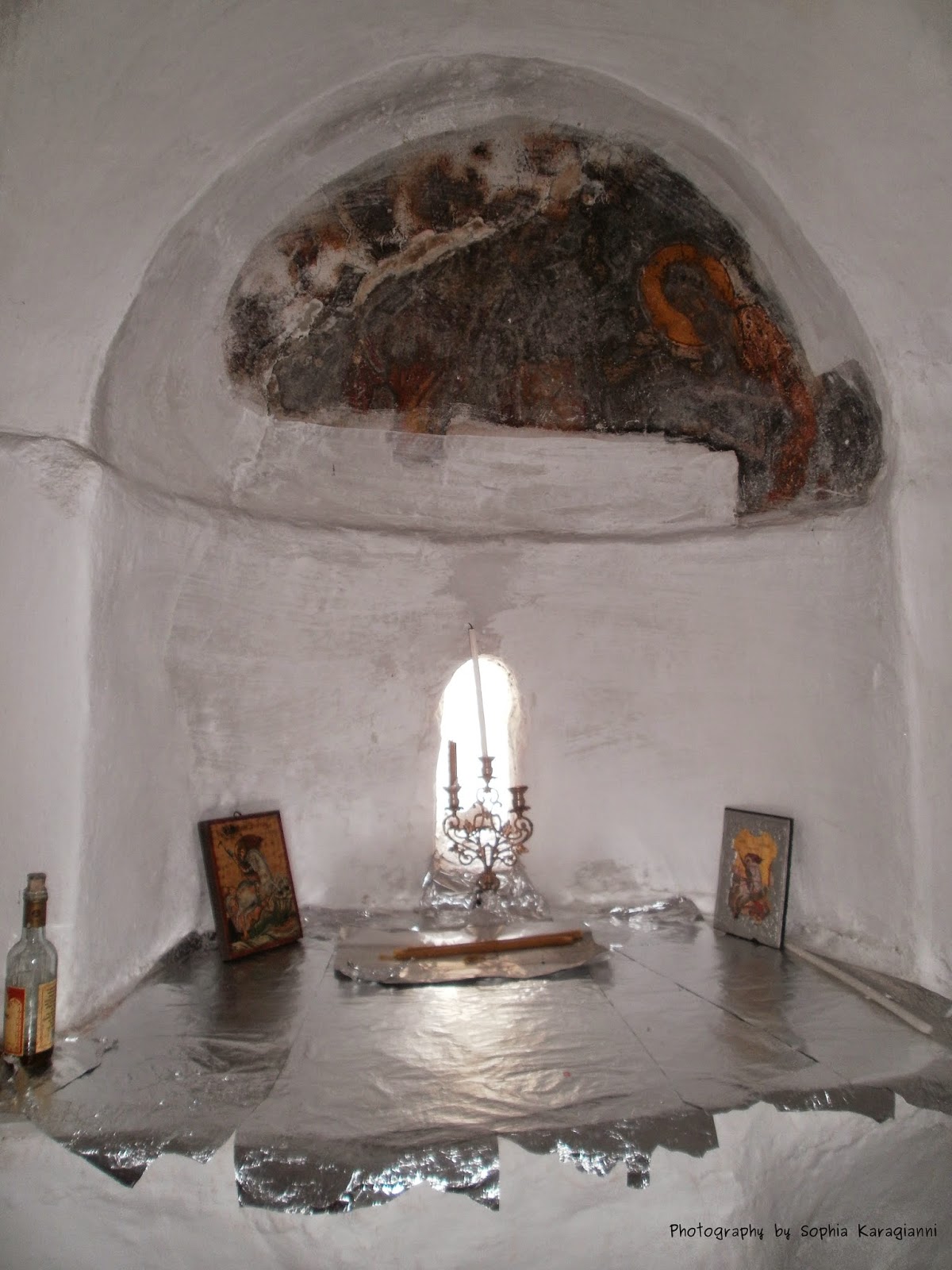
 Στις εσωτερικές επιφάνειες των τοίχων του ναού διατηρούνται
λείψανα τοιχογραφιών σε δύο στρώματα, ήτοι:
Στις εσωτερικές επιφάνειες των τοίχων του ναού διατηρούνται
λείψανα τοιχογραφιών σε δύο στρώματα, ήτοι:


Δρ ΙΩΑΝΝΟΥ ΗΛ. ΒΟΛΑΝΑΚΗ ΚΩΑΚΑ τ.Γ(1989) σελ. 85-89
Νότια
του οικισμού και σε απόσταση 600 μ. περίπου από αυτόν, στις παρυφές βραχώδους
υψώματος, κείται το ναϋδριο του Αγίου Γεωργίου.
Πρόκειται
για μικρών διαστάσεων μονόχωρο οικοδόμημα (εξωτ. διαστ. 6.60 Χ 3.95 μ.), που
καλύπτεται με κτιστή καμάρα, η οποία διαμορφώνεται εξωτερικά σε οριζόντια
στέγη. Ο ναός φαίνεται να προέρχεται από δύο τουλάχιστον οικοδομικές
περιόδους.
Το
ανατολικό τμήμα του ναού (εσωτ. διαστ.1.78 Χ 1.30 μ.) είναι παλαιότερο. Η
ανατολική αυτού πλευρά περατούται σε μίαν αψίδα (χορδής 1.28 και βέλου ς 0.72
μ.). Στις δύο μακρές πλευρές αυτού και εντός του πάχους των τοίχων ανοίγεται
ανά μία ημικυκλική κόγχη.
Το δυτικό τμήμα του ναού (εσωτ. διαστ. 4.20 Χ 2.30 μ.)
είναι ευρύτερο του ανατολικού και προστέθηκε αργότερα. Στο ανατολικό τμήμα της
βορείας και νοτίας εσωτερικής πλευράς αυτού ανοίγεται μέσα στο πάχος των τοίχων
ανά μία ημικυκλική κόγχη. Στο δυτικό άκρο της νοτίας εσωτερικής πλευράς
ανοίγεται μία ορθογωνίου σχήματος κόγχη, ενώ στο αντίστοιχο τμήμα της βορείας
πλευράς ανοίγεται η είσοδος (πλάτους 1.05 μ.).
Ι.
Ιερό Βήμα:
Τεταρτοσφαίριο: Στο τεταρτοσφαίριο της αψίδας του Ιερού Βήματος εικονίζεται, ως συνήθως, η Δέηση. Στο κέντρο της συνθέσεως παρίσταται ο Ιησούς Χριστός, ο οποίος ευλογεί με το δεξί του χέρι και κρατεί κλειστό κώδικα Ευαγγελίου με το αριστερό. Δίπλα από τον Χριστό υπάρχει η επιγραφή:
« IC XC
Ο CΩΤΗΡ»
Ήτοι, σε μεταγραφή: «Ί(ησου)ς
Χ(ριστό)ς, ό Σωτήρ».
ΙΙ. Κυρίως ναός
Νότιος τοίχος: Στην ανατολική κόγχη εικονίζονται οι
εξής Άγιοι (από Α. προς Δ.):
1. Ο Άγιος Γεώργιος
Παρίσταται ολόσωμος, όρθιος, μετωmκός, φέρων πλήρη στρατιωτική στολή. Με το δεξί του χέρι κρατεί ακόντιο και με το αριστερό ξίφος εντός θήκης με κατεύθυνση προς το έδαφος. Φορεί χλαμύδα και υποδήματα. Εκατέρωθεν της κεφαλής του Αγίου υπάρχει η επιγραφή:
«Ο AΓIOC
ΓEΩPΓIΟC».
Το πρόσωπο του Αγίου Γεωργίου είναι νεανικό, με ωραία χαρακτηριστικά. Η κόμη είναι βοστρυχωτή και τα ενδύματα διάλιθα.
2. Άγιος Παντελεήμων
Δυτικά του Αγίου Γεωργίου εικονίζεται ο Άγιος Παντελεήμων. Παρίσταται ολόσωμος, όρθιος, μετωπικός. Με το δεξί του χέρι φέρει μικρή λαβίδα και με το αριστερό κιβωτίδιο ξύλινο, σχήματος ορθογωνίου. Φορεί στιχάριο, στην παρυφή του οποίου υπάρχει κόσμημα, αποτελούμενον από ελικοειδή βλαστό σχηματοποιημένο. Επίσης φέρει φελόνιο, επιτραχήλιο και τα ενδύματά του είναι διάλιθα.
Δυτικά της ανατολικής
κόγχης υπάρχει διακοσμητικό σε δύο στρώματα.
3. Άγιος Ιωάννης ο
θεολόγος
Εικονίζεται ολόσωμος, στραμμένος προς την Θεοτόκον, κλίνων τον αυχένα. Κρατεί κώδικα Ευαγγελίου στα χέρια.
4. Θεοτόκος
Βρεφοκρατούσα
Στο κέντρο του τυμπάνου της δυτικής κόγχης της νοτίας εσωτερικής πλευράς του κυρίως ναού εικονίζεται η Θεοτόκος Βρεφοκρατούσα (αριστεροκρατούσα). Φορεί κυανόχρωμο, ποδόρη, χειριδωτό χιτώνα και βαθυπόρφυρο μαφόριο. Ίσταται πάνω σε βάθρο, κλίνουσα προς τα δεξιά.
Ο Ιησούς Χριστός παρίσταται ως Βρέφος. Φορεί λευκόχρωμο χιτώνα και με το αριστερό χέρι κρατεί συνεπτυγμένο ειλητάριο. Με τοδεξί ευλογεί.
Εκατέρωθεν της Θεοτόκου υπάρχει ημιεξίτηλος επιγραφή, η οποία έχει ως εξής:
«ΜΗΡ ΘΥ
Η ΚΗΔΩ ΚΤΗΜΙ».
Ήτοι, σε μεταγραφή: «Μή(τη)ρ Θ(εο)υ, ή Κηδώκτημι(;)>>.
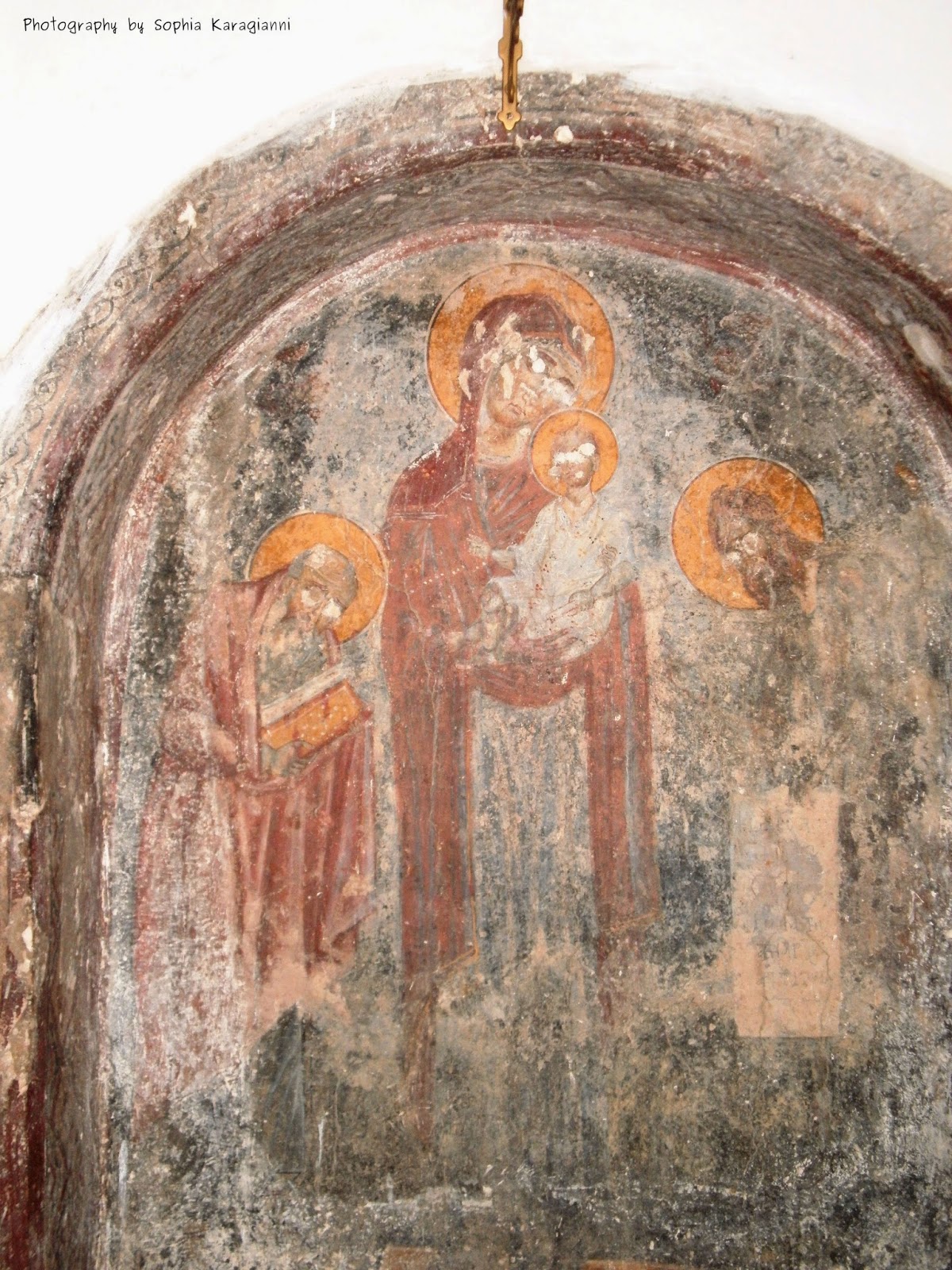

5. Άγιος Ιωάννης ο
Πρόδρομος
Εικονίζεται ολόσωμος, όρθιος, με κλίση της κεφαλής και του σώματος προς την Θεοτόκο.8S Ο ' Αγιος Ιωάννης κρατεί ανεπτυγμένο, ενεπίγραφο ειλητάριο, με το κείμενο: .
«+ ΙΔΕ Ο
Α
MNOC ΤΟΥ
ΘV Ο Ε
ΡΩΝ ΤΗΝ
ΑΜΑΡΤΙ.
Ν ΤΟΥ
ΚΩΣ
CMOY
Ήτοι, σε μεταγραφή: «+ Ιδε ό αμνός
του Θ(εο)υ, ό έρων τήν αμαρτί{α)ν του κώσμου». Στο εσωρράχιο του τόξου του δυτικού
τυφλού αψιδώματος υπάρχει διακοσμητικό, αποτελούμενο από ρόμβους και
ημιρόμβους.
Οι τοιχογραφίες αυτές είναι καλής ποιότητας και προέρχονται πιθανότατα από τον 15ο αι.

Ο Άη Γιώργης βρίσκεται νοτιοδυτικά της Ζιας στους πρόποδες του Δικαίου και στα παλιότερα βιβλία και έγγραφα φέρεται με την ονομασία "Θηριαύλης", "Θεριαύλης" ή "Θεριώτης" (πιθανότατα από το "Θηρίο" ή "Θεριό" που κατατρόπωσε ο Άγιος Γεώργιος). Είχε Πύργο, κελιά και κάποια περιουσία. Στον Κώδικα Α' της Μητροπόλεως Κω αναφέρονται δάνεια που δόθηκαν στο Ναό αυτό το 1766 και1774. Ο ιστοριοδίφης Ζαρράφτης αναφέρει ότι οι Τούρκοι σκότωσαν εκεί δύο μοναχούς. Παλιότερα στις 6 Αυγούστου κατεβαίνοντας από το Δίκαιο οι προσκυνητές συνέχιζαν το πανηγύρι εκεί. Οι τοιχογραφίες που διατηρούνται εντός του ναού, όπως του Αγίου Γεωργίου, της Θεοτόκου, του Προδρόμου, είναι του 15ου αιώνα και πολύ καλής ποιότητας.


 |
| από το εσωτερικό του ναού |
ΒΙΒΛΙΟΓΡΑΦΊΑ: ΤΟΙΧΟΓΡΑΦΗΜΕΝΟΙ
ΝΑΟΙ ΒΥΖΑΝΤΙΝΗΣ & ΜΕΤΑΒΥΖΑΝΤΙΝΗΣ ΕΠΟΧΗΣ Δρ ΙΩΑΝΝΟΥ ΗΛ.
ΒΟΛΑΝΑΚΗ-ΚΩΑΚΑ τ.Γ(1989) σελ. 85-89, Μάνος Μαστρογιώργης dikaiosnet, Το Ασφενδιού της Κω-Μανόλη Σ. Κιαπόκα (σελίδα 205)


 |
| Η ομάδα των πεζοπόρων έξω από το Θηριαύλη το Μάρτιο του 14, στην παρέα οι αείμνηστοι Μάνος Μαστρογιώργης και Αλέκος Κασιώτης |
Ακολουθεί η μετάφραση του κειμένου στα αγγλικά:
SAINT GEORGE THIRIAVLIS, or THERIAVLIS, or THERIOTIS, IN ZIA
From: Painted Churches of the Byzantine & Post-Byzantine Period
Dr. Ioannis I. Volanakis – KOAKA, vol. Γ (1989), pp. 85–89
Asfendiou, Zia, Saint George
South of the settlement and approximately 600 meters from it, on the foothills of a rocky elevation, lies the small church of Saint George.
It is a small, single-aisled building (external dimensions 6.60 × 3.95 m), covered with a built vault that forms a horizontal roof externally. The church appears to originate from at least two construction phases.
The eastern section (internal dimensions 1.78 × 1.30 m) is older. Its eastern side ends in an apse (chord 1.28 m and rise 0.72 m). On the two long sides, within the thickness of the walls, there is one semicircular niche on each side.
The western section (internal dimensions 4.20 × 2.30 m) is wider and was added later. In the eastern part of the north and south interior walls, one semicircular niche opens within the wall thickness. At the western end of the south interior wall there is a rectangular niche, while at the corresponding point on the north side is the entrance (1.05 m wide).
SAINT GEORGE THIRIAVLIS, or THERIAVLIS, or THERIOTIS, IN ZIA
From: Painted Churches of the Byzantine & Post-Byzantine Period
Dr. Ioannis I. Volanakis – KOAKA, vol. Γ (1989), pp. 85–89
Asfendiou, Zia, Saint George
South of the settlement and approximately 600 meters from it, on the foothills of a rocky elevation, lies the small church of Saint George.
It is a small, single-aisled building (external dimensions 6.60 × 3.95 m), covered with a built vault that forms a horizontal roof externally. The church appears to originate from at least two construction phases.
The eastern section (internal dimensions 1.78 × 1.30 m) is older. Its eastern side ends in an apse (chord 1.28 m and rise 0.72 m). On the two long sides, within the thickness of the walls, there is one semicircular niche on each side.
The western section (internal dimensions 4.20 × 2.30 m) is wider and was added later. In the eastern part of the north and south interior walls, one semicircular niche opens within the wall thickness. At the western end of the south interior wall there is a rectangular niche, while at the corresponding point on the north side is the entrance (1.05 m wide).
Wall Paintings
Remains of wall paintings survive on the interior wall surfaces in two layers:
I. Sanctuary (Holy Bema)
Conch of the apse:
In the semi-dome of the sanctuary apse, as usual, the Deesis is depicted. At the center stands Jesus Christ, blessing with His right hand and holding a closed Gospel codex in His left. Beside Christ appears the inscription:
“IC XC O COTHP”
That is, in transcription: “Jesus Christ, the Savior.”
II. Main Church
South Wall – Eastern Niche
Saint George
Depicted full-length, standing, frontal, wearing full military attire. In his right hand he holds a spear and in his left a sheathed sword pointing downward. He wears a cloak and footwear. On either side of his head is the inscription:
“O AGIOS GEORGIOS” (“Saint George”).
His face is youthful, with fine features. His hair is curly, and the garments are decorated with highlights.
Saint Panteleimon
West of Saint George stands Saint Panteleimon, full-length and frontal. In his right hand he holds a small pair of forceps and in his left a small rectangular wooden box. He wears a tunic with ornamental edging of stylized spiral vine motifs, as well as a phelonion and epitrachelion; his garments are highlighted.
West of the eastern niche there is decorative painting in two layers.
Saint John the Theologian
Depicted full-length, turned toward the Virgin, with his head inclined. He holds a Gospel codex.
The Virgin Mary Holding the Child (left-holding type)
In the centre of the tympanum of the western blind apse of the south interior wall appears the Virgin holding the Child. She wears a blue, ankle-length, sleeved tunic and a deep purple maphorion. She stands upon a pedestal, inclining slightly to the right.
Christ is depicted as an infant, wearing a white tunic. In His left hand He holds a rolled scroll, and with His right He blesses.
On either side of the Virgin is a partially faded inscription:
“MHΡ ΘΥ
H KHΔΩ KTHMI”
That is, in transcription: “Mother of God …”
Saint John the Forerunner (the Baptist)
Depicted full-length, standing, with head and body inclined toward the Virgin. He holds an unfurled inscribed scroll with the text:
“Behold the Lamb of God, who takes away the sin of the world.”
The paintings are of good quality and most likely date to the 15th century.
Historical Notes
Saint George (locally known as Thiriavlis / Theriavlis / Theriotis) lies southwest of Zia at the foothills of Mount Dikaios. In older books and documents it appears under those names, probably derived from “therio” (beast), referring to the beast slain by Saint George.
The monastery once had a tower, cells, and property. In Codex A of the Metropolis of Kos, loans granted to the church in 1766 and 1774 are recorded. The historian Zarráftis mentions that two monks were killed there by the Turks. In earlier times, on August 6, pilgrims descending from Mount Dikaios would continue the feast there.
The surviving frescoes — including those of Saint George, the Virgin, and Saint John the Forerunner — date to the 15th century and are of very fine quality.
The niches along the two long sides of the church recall churches of 13th-century Constantinople.
Bibliography:
Painted Churches of the Byzantine & Post-Byzantine Period, Dr. Ioannis I. Volanakis, KOAKA vol. Γ (1989), pp. 85–89; Manos Mastrogiogis (dikaiosnet); Asfendiou of Kos by Manolis S. Kiapokas (p. 205).
The hiking group outside Thiriavlis, March 2014. In the photo, you can see the late Manos Mastrogiorgis and the late Alekos Kasiotis.
Saint George (locally known as Thiriavlis / Theriavlis / Theriotis) lies southwest of Zia at the foothills of Mount Dikaios. In older books and documents it appears under those names, probably derived from “therio” (beast), referring to the beast slain by Saint George.
The monastery once had a tower, cells, and property. In Codex A of the Metropolis of Kos, loans granted to the church in 1766 and 1774 are recorded. The historian Zarráftis mentions that two monks were killed there by the Turks. In earlier times, on August 6, pilgrims descending from Mount Dikaios would continue the feast there.
The surviving frescoes — including those of Saint George, the Virgin, and Saint John the Forerunner — date to the 15th century and are of very fine quality.
The niches along the two long sides of the church recall churches of 13th-century Constantinople.
Bibliography:
Painted Churches of the Byzantine & Post-Byzantine Period, Dr. Ioannis I. Volanakis, KOAKA vol. Γ (1989), pp. 85–89; Manos Mastrogiogis (dikaiosnet); Asfendiou of Kos by Manolis S. Kiapokas (p. 205).
The hiking group outside Thiriavlis, March 2014. In the photo, you can see the late Manos Mastrogiorgis and the late Alekos Kasiotis.

Δεν υπάρχουν σχόλια:
Δημοσίευση σχολίου