
Σαν της Ωριάς το κάστρο, κάστρο δεν είδα.


 |
| η θέα από την Ωριά προς το Κάστρο |

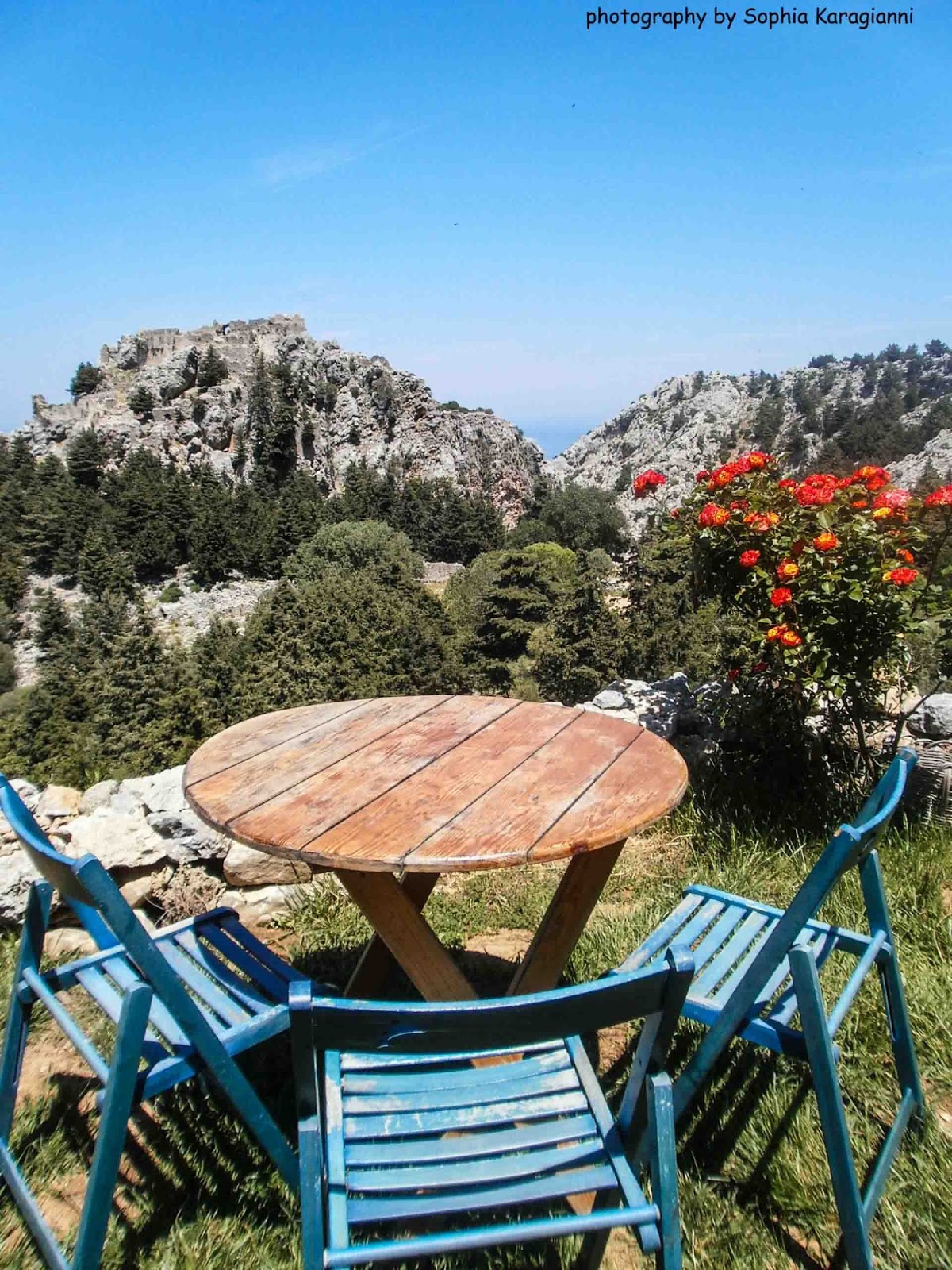


Η θέα είναι τουλάχιστον μεγαλειώδης. Από την ημέρα που άνοιξε, μέχρι και σήμερα, συνδυάζουμε ένα πέρασμα από την "Ωριά" με όλες τις πεζοπορίες στο Παλαιό Πυλί.


Ο καφές ψημένος με παραδοσιακό τρόπο και αν είστε τυχεροί, σαλάτες με ντόπια υλικά και κανένα μπριζολάκι κ άλλα μεζεδάκια της στιγμής.




 |
| οχιά σε χειμερία νάρκη |


 |
| Στην Ωριά θα δείτε και πέρδικες |
 |
| ο ιδιοκτήτης κ. Τσαμπουνιάρης στην Ωριά |
According to oral testimonies, the Castle of Palio Pyli is referred to as Oria’s Castle by the inhabitants of Pyli, just like approximately thirty other castles throughout Greece.
It is therefore logical—although this name is not recorded in the toponyms and anthroponyms of Kos (neither by Zarakas nor by Skandalidis)—that the café “Oria” borrowed its name from the hill on which the Castle of Palio Pyli stands, since they are located directly opposite one another.
The view from Oria towards the Castle
The name Oria or Orgia, according to Greek traditions and folk songs, signifies on the one hand a heroine, and on the other (as a derivative of the word Oraia, meaning “beautiful”) a beautiful woman.
According to the most prevalent version of the folk songs, Oria is sometimes presented as a Queen and at other times as a Princess of a castle. While under siege by Ottomans or Saracens, she defended it for many years until one of the besiegers managed to enter the castle. It is said that he was the son of a Greek woman and devised the following ruse in order to capture the impregnable fortress: he disguised himself as a pregnant woman (or, in other versions, as a monk), and upon reaching the castle gate he begged them to open it so that he could give birth (or rest from ascetic exhaustion, or seek refuge among fellow believers).
The man who devised the breach, acting in prior agreement with the leader of the besiegers, hastened to seize Oria in order to make her his wife. She, however, driven mad by despair, threw herself from the battlements of the castle and was killed.
From this narrative, the following folkloric elements emerge: Oria is a beautiful heroine of high status (Queen or Princess), the holder of a castle—an enclosed fortified structure of great importance, since it withstands continuous but unsuccessful sieges. The man who contrived its fall is portrayed as the son of a Greek woman, specifically a Christian (as indicated by the monk disguise), and at the end of the narrative the castle is referred to as the Chora (the main settlement).
Thus, about fifteen years ago—more precisely in 1999—the café of Oria appeared seemingly out of nowhere, opposite the hill of the Castle of Palio Pyli. Mr. Tsampouniaris began his venture with a single table, without electricity, in complete isolation, with its sole advantage being the view of the Castle.
Today, I can think of many reasons why you should visit “Oria” at least once.
1) The View
The view is truly magnificent. From the day it opened until today, a stop at Oria has been combined with all our hikes around Palio Pyli.
2) Access
Access is easy. There are three different routes leading to Oria: by car via a dirt road, or on foot along the stone-paved path through the settlement of Palio Pyli—either way, the visitor is rewarded by the sight. There is also a third small path, made for donkeys. For two years (2002–2003), donkeys transported visitors from the watering trough in old Pyli up to Oria. The signage still remains.
3) The Coffee
Coffee brewed in the traditional way, and if you are lucky, salads with local ingredients, a pork chop, and other small, improvised meze dishes of the moment.
4) The Decoration
Faithful to tradition, Mr. Tsampouniaris has created a wonderful space filled with traditional objects that capture the visitor’s attention and transport them to the past.
5) The Toilet
The unique toilet brings you into direct contact with nature, as it is outdoors and the ceiling is the blue sky itself. And if you are lucky—as we were today—you might even come across a viper in hibernation.
A viper in hibernation
6) History
A marble plaque and the ruins of a building very close to Oria testify to the existence of a church. Naturally, a visit to “Oria” is ideally combined with a visit to the Castle and settlement of Palio Pyli, Panagia ton Kastrianon, the Archangels (Asomatoi), and Saint Anthony—a true journey through the history of our land.
At Oria, you will also see partridges.
The owner, Mr. Tsampouniaris, at Oria

Δεν υπάρχουν σχόλια:
Δημοσίευση σχολίου