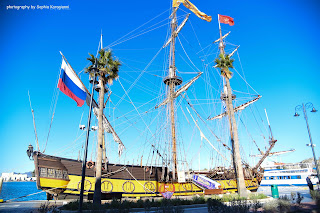
Η ΦΡΕΓΑΤΑ «SHTANDART» (Фрегат «Штандарт»)ΤΟ ΠΛΟΙΟ ΤΟΥ ΜΕΓΑΛΟΥ ΠΕΤΡΟΥ Η ΔΟΞΑ ΤΗΣ ΒΑΛΤΙΚΗΣ ΣΤΟ ΛΙΜΑΝΙ ΤΗΣ ΚΩ

 |
το λιοντάρι στην πλώρη και η χρονολογία 1703 |





 |
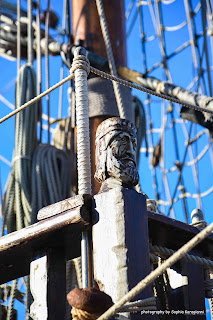
| απίστευτες ξυλόγλυπτες λεπτομέρειες |



 |
| αυτή η τρύπα ήταν η πρώτη τουαλέτα |


 |
| εκτός από τη ρωσική σημαία, δεσπόζει κι η αυθεντική τσαρική σημαία |
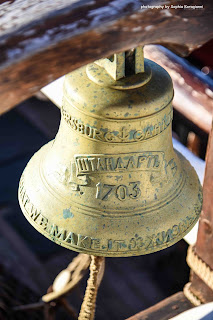 |
| η καμπάνα με την χρονολογία 1703 |
Vessel Type - Detailed: Sailing Vessel
Status: Active
MMSI: 273452840
Call Sign: UAEM
Flag: Russia [RU]
Length Overall x Breadth Extreme: 26 x 8 m
 |
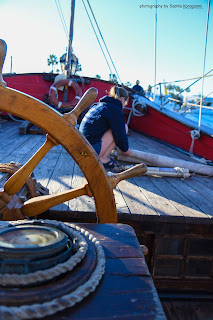
| χειροκίνητος εργάτης άγκυρας, όπου ξύλα μπαίνουν στις εσοχές και τα μέλη του πληρώματος σπρώχνουν τα ξύλα για να γυρίσει ο εργάτης και να τυλιχτεί η αλυσίδα της άγκυρας |

Φωτογραφίες: Sophia Karagianni
Ακολουθεί η μετάφραση του κειμένου στα αγγλικά:
The Frigate Shtandart (Фрегат «Штандарт»): Peter the Great's Ship – The Glory of the Baltic in the Port of Kos
For two or three days, the port of Kos hosted a remarkable historical Russian vessel—a replica of a ship of modest size but great historical significance. It is truly a feast for the eyes to see a 300-year-old sailing ship moored in the harbor. It transports visitors to another era, an age of pirates and naval battles, when none of the conveniences we know today existed and everything was accomplished by hand, long before the invention of engines and electricity.
The lion figurehead at the bow and the date 1703.
In recent months, the vessel has been sailing through the Aegean Sea as part of the “Flame of Chesme” research expedition, within the framework of the Greece–Russia Year of History. A month earlier, we encountered the frigate in Rhodes, where it was due to return the following day, but we did not have the opportunity to visit her then.
Today, however, we had the pleasure of touring the interior of the ship together with several students, guided by Kyriakos Iosifellis, a Greek member of the crew. According to Kyriakos, this impressive vessel travels throughout the world, relying primarily on its sails. Its mission is purely educational, and anyone interested can join the crew for as long as they wish, even without previous sailing experience.
Kyriakos, a lawyer from Athens, wanted to experience life aboard the frigate for a week. At the time, the ship carried a crew of thirty-one members from Russia and France, including Kyriakos himself and another Greek-Russian crew member. The crew learns to handle 160 different ropes, climbs the masts to furl and unfurl the sails, and sleeps in hammocks.
We learned many fascinating details about the ship's ventilation system, the sanitary facilities used by early sailors, the method for raising the anchor, the adjustment of the sails according to wind direction by simultaneously tightening and loosening ropes, and the ceremonial cannon salute that would be fired that evening to mark the New Year.
The Original Frigate
The frigate Shtandart, also known as Peter the Great's Frigate, was the first vessel of the Russian Baltic Fleet. Its keel was laid on 24 April 1703 at the Olonetsky Shipyard, near Olonets, by decree of Tsar Peter I.
Exquisite carved wooden details.
The ship was built by the Dutch shipbuilder Vybe Gerens under the direct supervision of the Tsar himself. It served as the first flagship of the Imperial Russian Navy and remained in service until 1727. The name Shtandart reflected Peter the Great's ambition to secure access to the Baltic Sea, which at the time was dominated by the Swedish Empire.
The Modern Replica
In 1994, a small group of sailing enthusiasts led by Vladimir Martus began constructing a replica of the historic vessel. Martus developed a revised design for the Shtandart, incorporating four bulkheads that divided the ship into five compartments.
This opening served as the first shipboard toilet.
The Shtandart Project, a non-governmental, non-profit organization dedicated to youth education, launched the replica frigate on 4 September 1999. Its next ports of call were scheduled to be Rhodes, Santorini, and Piraeus.
Alongside the Russian flag flies the original Tsarist naval ensign.
The ship's bell bears the date 1703.
Vessel Specifications
Vessel Type: Sailing Vessel
Status: Active
MMSI: 273452840
Call Sign: UAEM
Flag: Russia [RU]
Length Overall × Breadth Extreme: 26 × 8 m
Manual anchor windlass: wooden bars are inserted into the sockets, and crew members push them to rotate the mechanism, allowing the anchor chain to be wound in by hand.
