The Church of Saint Paraskevi is the oldest of the three parish churches in Kos Town. It is located in the town centre, in the district once known as the Aspa Quarter (today's Halvazia area).
The earliest known reference to Saint Paraskevi in the Aspa district dates to 1693, in Codex A of the Archive of Doulia. Historical records indicate that until 1721 the church was at least partly privately owned, but from that year onwards it became the sole property of the Community of Kos.
By 1763, it had become a parish church and was the wealthiest parish church in Kos Town. Around 1800, the church owned twenty-one houses, as the buying and selling of small houses between private citizens and parish churches was common practice at the time. One surviving document records that in 1825, Maria, the wife of Nikolis, sold her house in the Aspa district, on what was then known as Peis Sokaki, to the Church of Saint Paraskevi for 120 grosia, receiving the payment from the church.
Embedded in the floor of the old church was a Roman inscription carved on a white stone, reading:
"The Senate (of the Koans) honoured Gaius Valerius Ulpianus with a statue..."
- The Construction of the Present Church
In 1915 and 1918, two associations of emigrants from Kos were founded in the United States: one named Elpis (Hope) and the other Saint Paraskevi, with the aim of financing the construction of a new church in Kos.
When the Community requested the transfer of the funds collected, it was informed that this would not be possible. According to the conditions set by the donors, the money—amounting to almost 200,000 francs—could only be released once the existing church had been demolished.
Saint Paraskevi on 23 July 1967, the day of my parents' wedding, photographed by my father (from my personal archive).
Saint Paraskevi today.
In 1927, a committee was appointed to oversee the construction of the new church and commissioned the Italian engineering firm Castelli to prepare plans for its complete reconstruction. The designs were produced in Rome by the architect and Byzantine specialist Orsini.
Government permission was granted in 1928, and the foundation stone was laid on 8 March 1931, following a blessing conducted by Archimandrite Philemon in the presence of a large congregation.
Access to the church from Herakleous Street.
Construction stopped later in 1931 due to financial difficulties. Achilleas Mouzakis personally guaranteed a loan from the Bank of Sicily, enabling the work to continue.
The church was completed on 18 December 1932, when the first Divine Liturgy was celebrated.
Remarkably, during the devastating earthquake of 21 April 1933, the church was only four months old. Although a service was taking place when the earthquake struck, the building suffered no damage whatsoever, and none of the worshippers were injured, despite the complete destruction of much of the surrounding Aspa neighbourhood.
The rear of the church, photographed in winter and autumn.
My research suggests that the original church existed from 1693 until its complete rebuilding beginning in 1928. The stipulation made by the expatriate associations in America—that the funds would only be released for a complete reconstruction "on the very site where it now stands"—raises several questions. What condition was the old church in? Why was it not simply repaired? Why was there such insistence on rebuilding it from the ground up? And when exactly was the original church demolished? I have been unable to find any record documenting its demolition.
Further uncertainty arises from the writings of Ioannis Zarraftis, who, referring to the Defterdar Mosque, built in 1786, claimed that it was "a wealthy foundation dating from a period before the Turkish conquest", thereby supporting the local tradition that it had originally been a Christian church dedicated to Saint Paraskevi.
The ancient column with its Corinthian capital that once dominated the rear of the church.
It seems reasonable to assume that, by the early twentieth century, the old church had become unsafe due either to repeated earthquakes or inadequate maintenance. Indeed, for a period the parishioners of the Aspa district attended services at the nearby Church of Panagia tou Forou, which has since disappeared.
In 1938, thanks to a donation from Mayor Georgios Ipp. Ioannidis, half of the marble bishop's throne was constructed. It was completed in 1959 by his wife.
Work on the magnificent marble iconostasis began in 1946, replacing the original wooden one. Both the iconostasis and the bishop's throne were carved by the Kalymnian sculptor M. Tiliakos, who was instructed to use marble from Kos.
The icons of the iconostasis, executed in a Renaissance style, were painted by the Kalymnian iconographer Antonis Karafyllakis.
The church's wall paintings were completed in 1985 by the iconographers Stamatios Zegiannis, Nikolaos Vlachogiannis, and Victor Stoupkas, while the marble pulpit was created by another Kalymnian craftsman, Mikis Gavalas.
Interior photographs of the church after the earthquake of 21 July 2017.
The church was consecrated by Metropolitan Emmanuel on 6 May 1951.
Its bell tower, the tallest in Kos, was completed in early 1967 and houses three bells.
Architecturally, the church is a three-aisled Byzantine-style basilica with a dome. The right aisle is dedicated to the local New Martyr Saint John the Navigator, while the left aisle is dedicated to Saint Xenia.
- Relics and Parish Buildings
The building opposite the church, formerly known as the Thymanakeios School (the Mixed Primary School), now houses a parish events hall.
The church preserves a relic of Saint Paraskevi, which is presented for veneration by the faithful each year on 26 July, the saint's feast day.
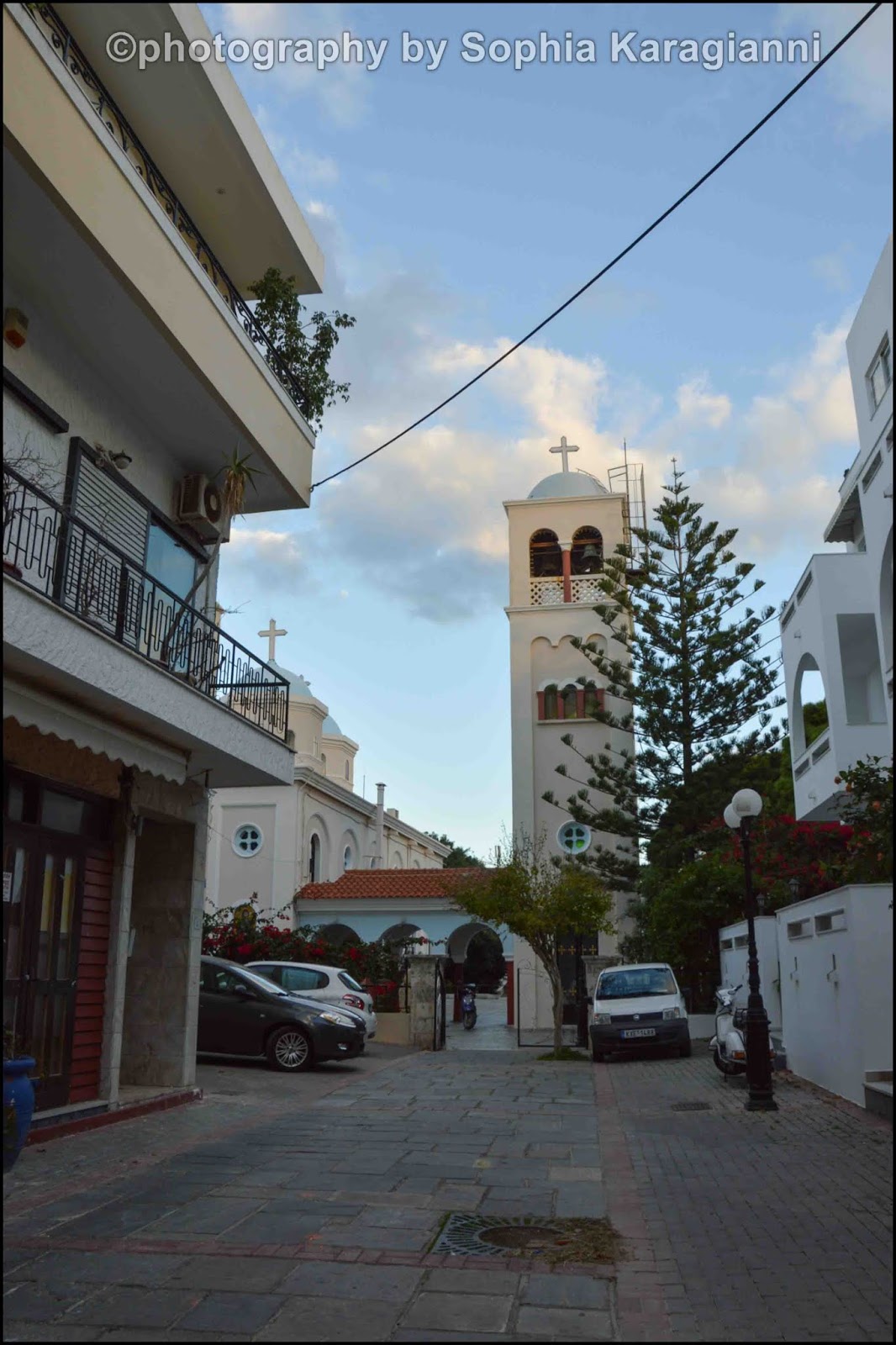
The narrow street leading to Saint Paraskevi from Eleftheriou Venizelou Street.
Ancient architectural members can still be seen incorporated into the church walls and scattered throughout the church courtyard.
Details of the pebble mosaic paving in the church courtyard.
- The Wayside Shrine of Saint Paraskevi
The small roadside shrine of Saint Paraskevi stands at the beginning of Hippokratous Street, directly opposite the Church of Saint Constantine.
It survived both the 1933 and 2017 earthquakes, as well as the large-scale demolitions carried out during the Italian period. Incorporated into its masonry are Early Christian architectural fragments, and the lamp burning inside the shrine remains permanently lit.
- The House of Asclepius (3rd Century AD)
The House of Asclepius occupies the area extending from Saint Paraskevi Square to Eleftheriou Venizelou Street, within the historic Aspa district where the Greek Orthodox population lived before the earthquake of 1933.
Excavated by the Italian Archaeological Mission, it was a luxurious Roman villa built upon the remains of an earlier Hellenistic-period building.
One of its reception rooms (cubiculum) contained the celebrated mosaic depicting the arrival of Asclepius on Kos, dating from the first half of the 3rd century AD. The mosaic is now exhibited in the courtyard of the Archaeological Museum of Kos.
The villa derives its modern name from this remarkable mosaic. Today, parts of the building remain visible among the municipal flowerbeds, including an apse that may once have belonged to a nymphaeum.
- The Earthquake of 21 July 2017
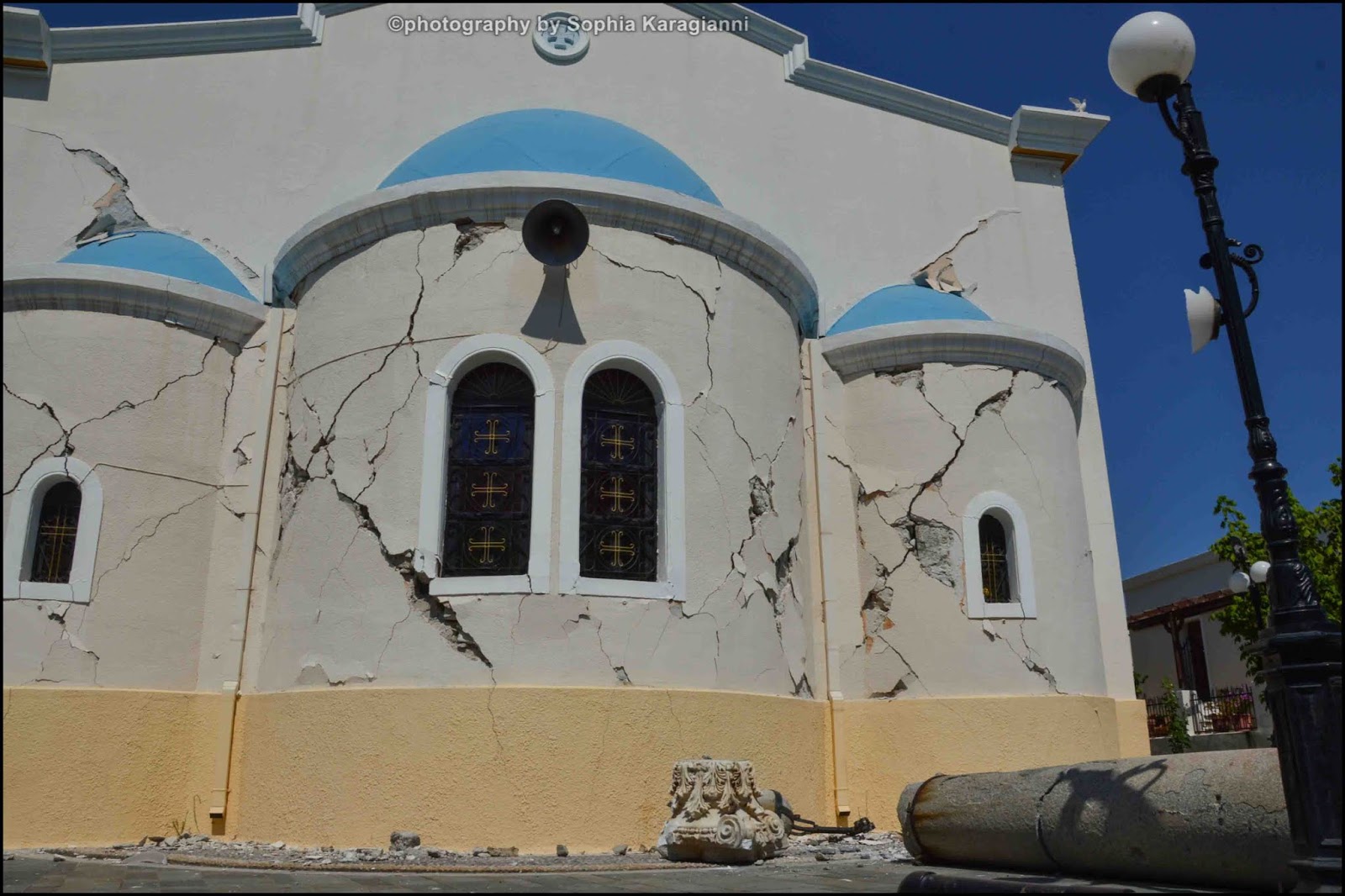
What the earthquake of 1933 failed to do, the devastating earthquake of 21 July 2017 accomplished.
The Church of Saint Paraskevi suffered extensive structural damage. One year later, restoration work had still not been completed. The church remained closed for an entire year and reopened for worship for the first time on 25 July 2018, the eve of the saint's feast, with worshippers entering at their own risk.
Update: Restoration of the Holy Cathedral of Saint Paraskevi was completed, and the church was officially returned to the local community on 1 April 2023, almost six years after the deadly earthquake of 21 July 2017.